 9f12161dc9
Bumps [axios](https://github.com/axios/axios) from 1.8.1 to 1.8.2. - [Release notes](https://github.com/axios/axios/releases) - [Changelog](https://github.com/axios/axios/blob/v1.x/CHANGELOG.md) - [Commits](https://github.com/axios/axios/compare/v1.8.1...v1.8.2) --- updated-dependencies: - dependency-name: axios dependency-type: direct:production ... Signed-off-by: dependabot[bot] <support@github.com> |
||
|---|---|---|
| .devcontainer | ||
| .github | ||
| app | ||
| bootstrap | ||
| config | ||
| database | ||
| docker | ||
| public | ||
| resources | ||
| routes | ||
| screenshots | ||
| storage | ||
| tests | ||
| .dockerignore | ||
| .editorconfig | ||
| .env.example | ||
| .gitattributes | ||
| .gitignore | ||
| artisan | ||
| composer.json | ||
| composer.lock | ||
| docker-compose.yml | ||
| Dockerfile | ||
| example.png | ||
| LICENSE.md | ||
| package-lock.json | ||
| package.json | ||
| phpunit.xml | ||
| README.md | ||
| README_byos-screenshot.png | ||
| vite.config.js | ||


TRMNL BYOS (PHP/Laravel)

Laravel Trmnl Server is a self-hostable implementation of a TRMNL server, built with Laravel. It enables you to manage TRMNL devices, generate screens dynamically, and can act as a proxy for the TRMNL API (native plugin system). Inspired by usetrmnl/byos_sinatra.
If you are looking for a Laravel package designed to streamline the development of both public and private TRMNL plugins, check out bnussbau/trmnl-laravel.
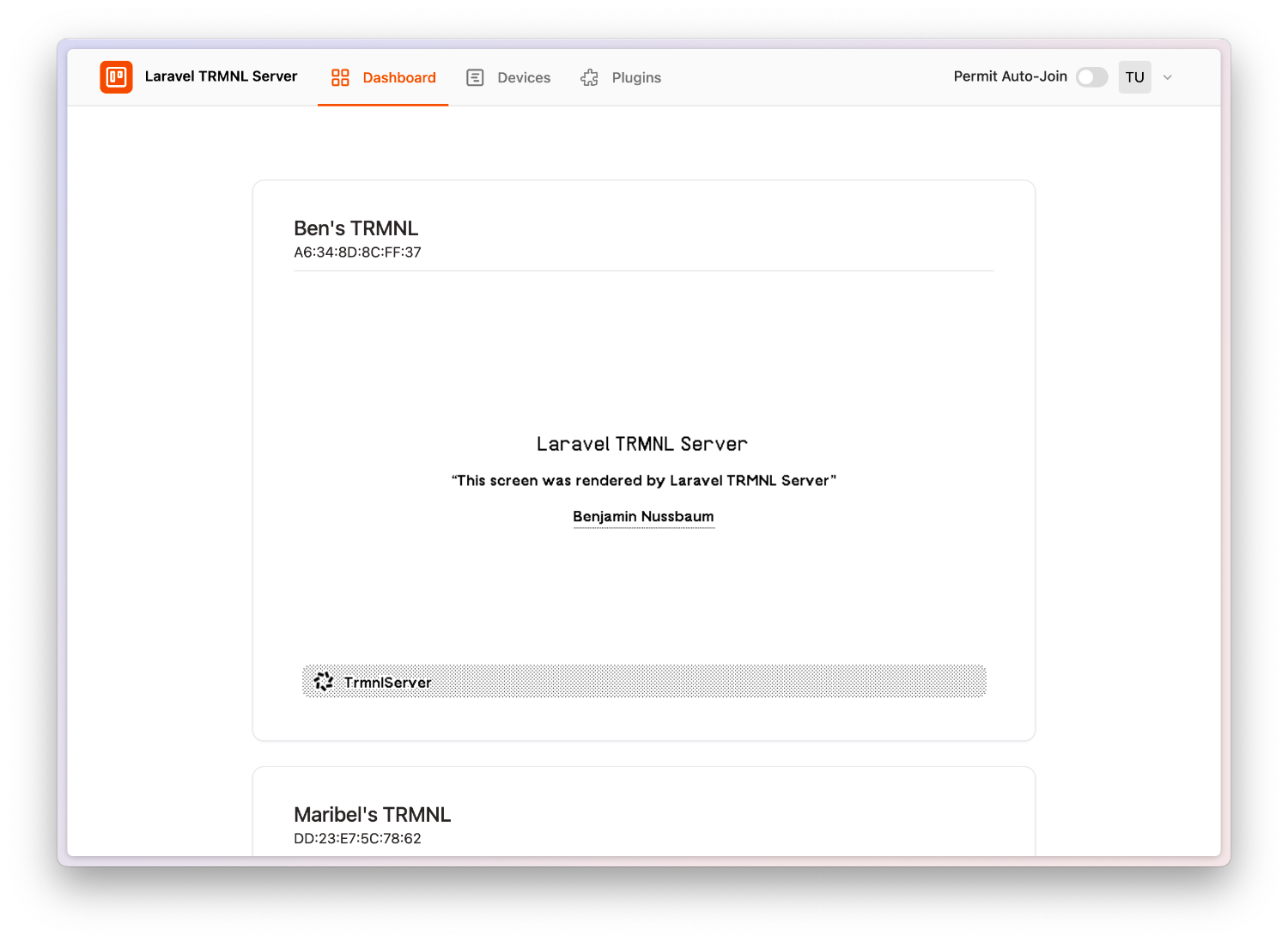
Key Features
- 📡 Device Information – Display battery status, WiFi strength, firmware version, and more.
- 🔍 Auto-Join – Automatically detects and adds devices from your local network.
- 🖥️ Screen Generation – Supports Markup, API, or update via Code.
- 🔄 TRMNL API Proxy – Can act as a proxy for the TRMNL Display API (requires TRMNL Developer Edition).
- This enables a hybrid setup – for example, you can update your custom Train Monitor every 5 minutes in the morning, while displaying native TRMNL plugins throughout the day.
- 🐳 Deployment – Dockerized setup for easier hosting (Dockerfile, docker-compose).
- 🛠️ Devcontainer support for easier development.
🎯 Target Audience
This project is for developers who are looking for a self-hosted server for devices running the TRMNL firmware. It serves as a starter kit, giving you the flexibility to build and extend it however you like.
Support ❤️
This repo is maintained voluntarily by @bnussbau.
Support the development of this package by purchasing a TRMNL device through our referral link: https://usetrmnl.com/?ref=laravel-trmnl. At checkout, use the code laravel-trmnl to receive a $15 discount on your purchase.
Requirements
- PHP >= 8.2
- ext-imagick
- puppeteer see Browsershot docs
Installation
Clone the repository
git clone git@github.com:bnussbau/laravel-trmnl-server.git
Copy environment file
cp .env.example .env
php artisan key:generate
Install dependencies
composer install
npm i
Run migrations
php artisan migrate --seed
Run the server
To make your server accessible in the network, you can run the following command:
php artisan serve --host=0.0.0.0 --port 4567
Docker
Use the provided Dockerfile, or docker-compose file to run the server in a container.
You can persist the database file by mounting a volume to /var/www/html/database/database.sqlite.
# docker-compose.yaml
volumes:
    - ./database/database.sqlite:/var/www/html/database/database.sqlite
Usage
Environment Variables
| environment | description | default |
|---|---|---|
TRMNL_PROXY_BASE_URL |
Base URL of the native TRMNL service | https://trmnl.app |
TRMNL_PROXY_REFRESH_MINUTES |
How often should the server fetch new images from native service | 15 |
REGISTRATION_ENABLED |
Allow user registration via Webinterface | 1 |
FORCE_HTTPS |
If your server handles SSL termination, enforce HTTPS. | 0 |
Login
If your environment is local, you can access the server at http://localhost:4567 and login with user / password
admin@example.com / admin@example.com, otherwise register. With environment variable REGISTRATION_ENABLED you can control, if registration is allowed.
➕ Add Your TRMNL Device
Auto-Join (Local Network)
- Switch on the “Permit Auto-Join” toggle in the header. For that to work only one user can be registered.
- New devices on your local network will be detected and added automatically when connecting to the server.
✅ This is the easiest way to connect your devices with minimal effort.
Manually
- Open the Devices page: 👉 http://localhost:4567/devices
- Click “Add New Device”.
- Retrieve your TRMNL MAC Address and API Key:
- You can grab the TRMNL Mac Address and API Key from the TRMNL Dashboard
- Alternatively, debug incoming requests to /api/setup to determine them
⚙️ Configure Server for Device
📌 Firmware Version 1.4.6 or Newer
- Setup device
- After entering Wifi credentials, choose "Custom Server"
- Point to the URL of your server
Firmware Older Than 1.4.6
If your device firmware is older than 1.4.6, you need to flash a new firmware version to point it to your server.
See this YouTube guide: https://www.youtube.com/watch?v=3xehPW-PCOM
🖥️ Generate Screens
🎨 Blade View
- Edit
resources/views/trmnl.blade.php- Available Blade Components are listed here: laravel-trmnl | Blade Components
- To generate the screen, run
php artisan trmnl:screen:generate
Generate via API
You can dynamically update screens by sending a POST request.
- Send a POST request to
/api/screenwith the following payload
Header
Authorization Bearer <TOKEN>
Body
{
    "markup": "<h1>Hello World</h1>"
}
Token can be retrieved under Plugins > API in the Web Interface.
Markup via Web Interface
- Navigate to Plugins > Markup in the Web Interface.
- Enter your markup manually or select from the available templates.
- Save and apply the changes.
- Available Blade Components are listed here: laravel-trmnl | Blade Components
🛠️ Generate Screens Programmatically
You can fetch external data, process it, and generate screens dynamically.
- Fetch data from an external source.
- Either render it in a Blade view or directly insert markup.
- Use Laravel’s scheduler to automate updates.
📌 Example: Fetch Train Monitor Data
This example retrieves data from trmnl-train-monitor and updates the screen periodically.
Step 1: Create a new Artisan Command
php artisan make:command PluginTrainMonitorFetch
Step 2: Edit PluginTrainMonitorFetch.php
class PluginTrainMonitorFetch extends Command
{
    protected $signature = 'plugin:train:fetch';

    protected $description = 'Fetches train monitor data and updates the screen';

    public function handle(): void
    {
        $markup = Http::get('https://oebb.trmnl.yourserver.at/markup')->json('markup');
        GenerateScreenJob::dispatchSync(1, $markup);
    }
}
Step 3: Schedule the Command in console.php
Schedule::command('plugin:train:fetch')
    ->everyFiveMinutes()
    ->timezone('Europe/Vienna')
    ->between('5:00', '18:00');
This will automatically update the screen every 5 minutes between 5:00 AM and 6:00 PM local time.
🏗️ Roadmap
Here are some features and improvements that are open for contribution:
🔌 Plugin System
- Enable configurable plugins via the Web Interface.
- Ensure compatibility with the trmnl-laravel package.
- Implement auto-discovery for plugins.
⏳ Scheduling
- Move task scheduling from console.php to a Web Interface.
- Allow users to configure custom schedule intervals.
🖥️ “Native” Plugins
- Add built-in plugins such as (as an example):
- ☁️ Weather
- 💬 Quotes
- 🏡 Home Assistant integration
- Provide Web UI controls to enable/disable plugins.
📦 Visual Studio Code Devcontainer
Add a .devcontainer to this repo for easier development with Docker.✅
Improve Code Coverage
- Expand Pest tests to cover more functionality.
- Increase code coverage (currently at 86.9%).
🤝 Contribution
Contributions are welcome! If you’d like to improve the project, follow these steps:
- Open an Issue
- Before submitting a pull request, create an issue to discuss your idea.
- Clearly describe the feature or bug fix you want to work on.
- Fork the Repository & Create a Branch
- Make Your Changes & Add Tests
- Ensure your code follows best practices.
- Add Pest tests to cover your changes.
- Run Tests
php artisan test
- Submit a Pull Request (PR)
- Push your branch and create a PR.
- Provide a clear description of your changes.
Thank you for contributing!
License
MIT